
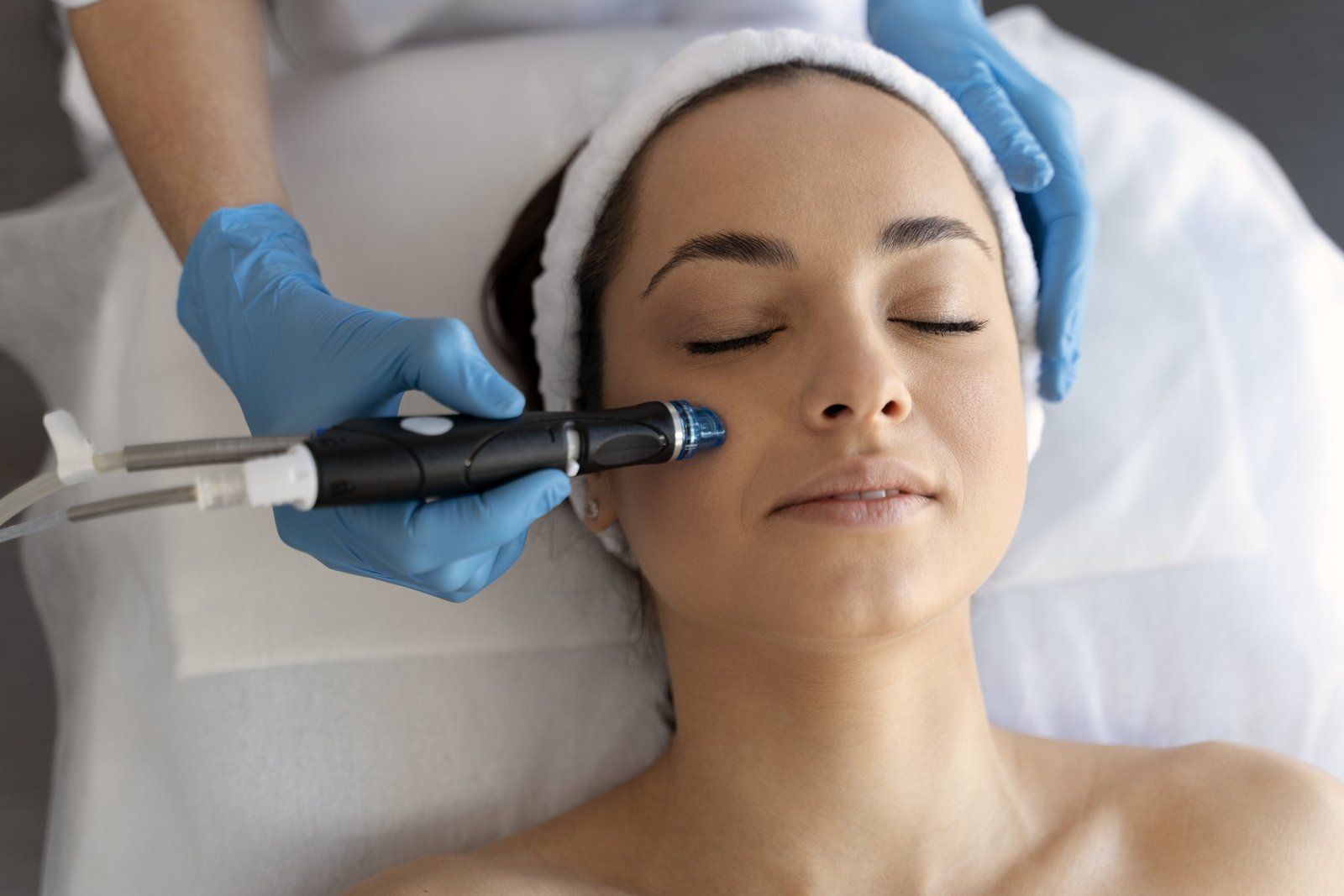
DiamondGlow vs. HydraFacial: Which Facial Suits Your Skin?
DiamondGlow® and HydraFacial MD® are more alike than different. Both exfoliate, clear out pores with gentle suction and finish by working a serum into your skin, and both have little to no downtime. The main difference is how they exfoliate: DiamondGlow uses a diamond-tip wand, while HydraFacial relies on acid-based serums. Which suits you depends on your skin and what you want it to do.
Center for Plastic Surgery offers both, so here is how they compare, what the research actually shows, and how to decide.
How Each Treatment Works
Both treatments follow the same basic order: exfoliate, extract, then hydrate or infuse. They belong to the same family as microdermabrasion. A 2008 study in the Journal of Cosmetic Dermatology described this kind of treatment as "crystal-free microdermabrasion with the pneumatic application of an antioxidant-based serum".
HydraFacial MD®
As our HydraFacial MD® page describes it, your treatment is customized from four steps:
Exfoliate: a serum containing lactic and glycolic acid loosens dull, dead skin cells.
Peel: glycolic and salicylic acids exfoliate further, without the side effects of stronger peels. You shouldn't experience scaling afterward.
Extract: gentle suction clears impurities from the pores.
Hydrate: a serum of peptides, antioxidants and hyaluronic acid is applied to smooth and hydrate.
DiamondGlow®
Our DiamondGlow® page describes a single handpiece that does three things at once. A diamond-tip wand removes dull surface cells, suction lifts oil and build-up from the pores, and a SkinMedica® Pro-Infusion Serum chosen for your skin is infused while the device works. That makes the exfoliation mechanical rather than chemical. The American Society of Plastic Surgeons describes the diamond-tip approach as "the newer approach" to microdermabrasion, one that is "gently moved across your skin to exfoliate."
DiamondGlow vs. HydraFacial at a Glance
| HydraFacial MD® | DiamondGlow® | |
|---|---|---|
| How it exfoliates | Acid-based serums (lactic, glycolic and salicylic) | A diamond-tip wand |
| Pore clearing | Suction | Suction, in the same pass |
| What goes in | Peptides, antioxidants and hyaluronic acid | A SkinMedica® Pro-Infusion Serum chosen for your skin |
| Listed concerns | Fine lines, acne and blemishes, uneven tone, age spots and sun damage, under-eye bags | Dullness, rough texture, dryness, congested pores, uneven tone, fine lines |
| Downtime | Little to none | Minimal |
Source: Center for Plastic Surgery's HydraFacial MD® and DiamondGlow® treatment pages.
Which One Suits Your Skin?
For many people, either one is a reasonable place to start. The lists of concerns overlap heavily, and both are designed to refresh the skin, not to correct deeper problems. Still, a few things can tip the choice:
Rough texture or dullness: DiamondGlow's diamond tip physically polishes the surface, and texture, dullness and congested pores are what our page lists it for.
Breakouts and blemishes: HydraFacial's peel step uses salicylic acid, and our page lists reducing acne and blemishes among its uses.
A history of reacting to acids: if glycolic or salicylic acid products have irritated your skin before, tell your provider. HydraFacial's exfoliation depends on them, while DiamondGlow's comes from the wand.
An event coming up: both are popular for this. Our DiamondGlow page names a polished look before an event as one of its uses, and our HydraFacial page notes that improvements show right after treatment.
If you are torn, that is normal. Our DiamondGlow page puts it simply: our licensed aestheticians "will look at your skin, ask what has and has not worked for you before, and tell you honestly whether DiamondGlow® is the right place to start." The same visit works for HydraFacial. If what bothers you most is loose skin or deep lines, neither facial is the right tool, as the section on limits below explains.
What the Research Shows, and What It Doesn't
Less than the marketing suggests. Plenty of articles name one of these facials the clear winner. We did not find a head-to-head study comparing them, and the studies that do exist are small:
DiamondGlow: in a 2024 study of 29 women, six DiamondGlow treatments two weeks apart, combined with an at-home serum, were well tolerated and improved several signs of sun-related aging. The study was run by the device's maker, Allergan Aesthetics.
HydraFacial: in a 2022 study of 20 adults with mild to moderate acne, six HydraFacial Clarifying Treatments every two weeks raised the share of patients with clear or almost clear skin from 20 to 65 percent, by investigator assessment. One author worked for The HydraFacial Company.
The bigger picture: researchers imaging the skin before and after the procedure in a 2024 study of eight volunteers noted that clinical studies validating its efficacy "are scarce." Two weeks after one treatment, they saw no visible difference in collagen.
None of this means the treatments don't work. It means the published results come from small studies, two of them tied to the device makers, and they describe a series of treatments rather than a single visit.
Side Effects and Limits
Both are gentle, but not without side effects. The American Society of Plastic Surgeons lists these for microdermabrasion, the category both treatments belong to:
Redness and swelling, which usually settle within a few hours
Flaky, dry skin for several days afterward
Bruising from the suction, which may last several days
Greater sensitivity to the sun, so wear sunscreen, especially right after a session
The limit matters as much as the side effects. Our DiamondGlow page calls it "a resurfacing treatment rather than a corrective procedure," and the same is true of HydraFacial. Neither one will lift loose skin, soften deep folds or replace lost volume. If those are your real concerns, a consultation can map out which treatments do. Our surgeons and team cover everything from injectables to surgery.
How Often Should You Book?
It depends on your skin and your goals, which is why neither of our treatment pages gives a fixed number. For microdermabrasion in general, ASPS notes that "many people have two microdermabrasion treatments per month at first and then one per month as part of a maintenance plan." The two device studies above used a similar rhythm, with treatments two weeks apart for 12 weeks.
Some people book an occasional session before a big day, while others build one into a regular routine. Between visits, your home skincare does much of the work. Our HydraFacial page notes that with the right routine you can maintain your results, and our team can recommend products to help. If you are curious about extras, our earlier post covers what you can add to a HydraFacial.
If you are planning a series and want to understand fees, our pricing and cost information page explains how they are structured.
Interested in a HydraFacial or DiamondGlow in Washington, D.C.?
At Center for Plastic Surgery, our registered nurses and licensed aestheticians work closely with our board-certified plastic surgeons to plan skin treatments around what your skin actually needs. We see patients from Washington, DC, Chevy Chase, Bethesda, Arlington, Fairfax, and surrounding areas. Our HydraFacial MD® page lists the treatment at our Tysons Corner location, so mention which facial you are interested in when you call. Call our Chevy Chase office at (301) 652-7700 or our Tysons Corner office at (703) 560-2850, or request a consultation.
Frequently Asked Questions
How long do HydraFacial and DiamondGlow results last?
Our HydraFacial page notes that improvements show right after treatment. ASPS says microdermabrasion results can be long-lasting, depending on how much skin damage you started with and how many treatments you have. A good home skincare routine helps you keep the improvement between visits. Neither treatment stops your skin from aging, which is why many people book a maintenance schedule.
What does each treatment feel like?
Most people find both comfortable. ASPS describes diamond-tip microdermabrasion as a mild scratching feeling with a vibration "akin to a massage," plus suction lifting away dead skin. HydraFacial uses a gentler, serum-based peel, and our page notes the peel step should feel comfortable. Tell your provider if anything feels too strong; our DiamondGlow page describes the provider adjusting the technique to suit your skin.
Who performs these treatments at Center for Plastic Surgery?
Our registered nurses and licensed aestheticians, who work closely with our board-certified plastic surgeons. Before your first treatment, they look at your skin and listen to your concerns, then customize the treatment to you. If they think another option would serve you better, they will say so.
Can I add anything to my facial?
Yes, with HydraFacial. It can be performed alone or with add-ons, such as Perk Eye treatment for the eye area or Perk Lip treatment for the lips. Our HydraFacial page also describes the Alastin HydraFacial Booster. With DiamondGlow, the customization comes from the Pro-Infusion Serum your provider chooses for your skin.

About the Author
October 7, 2026